
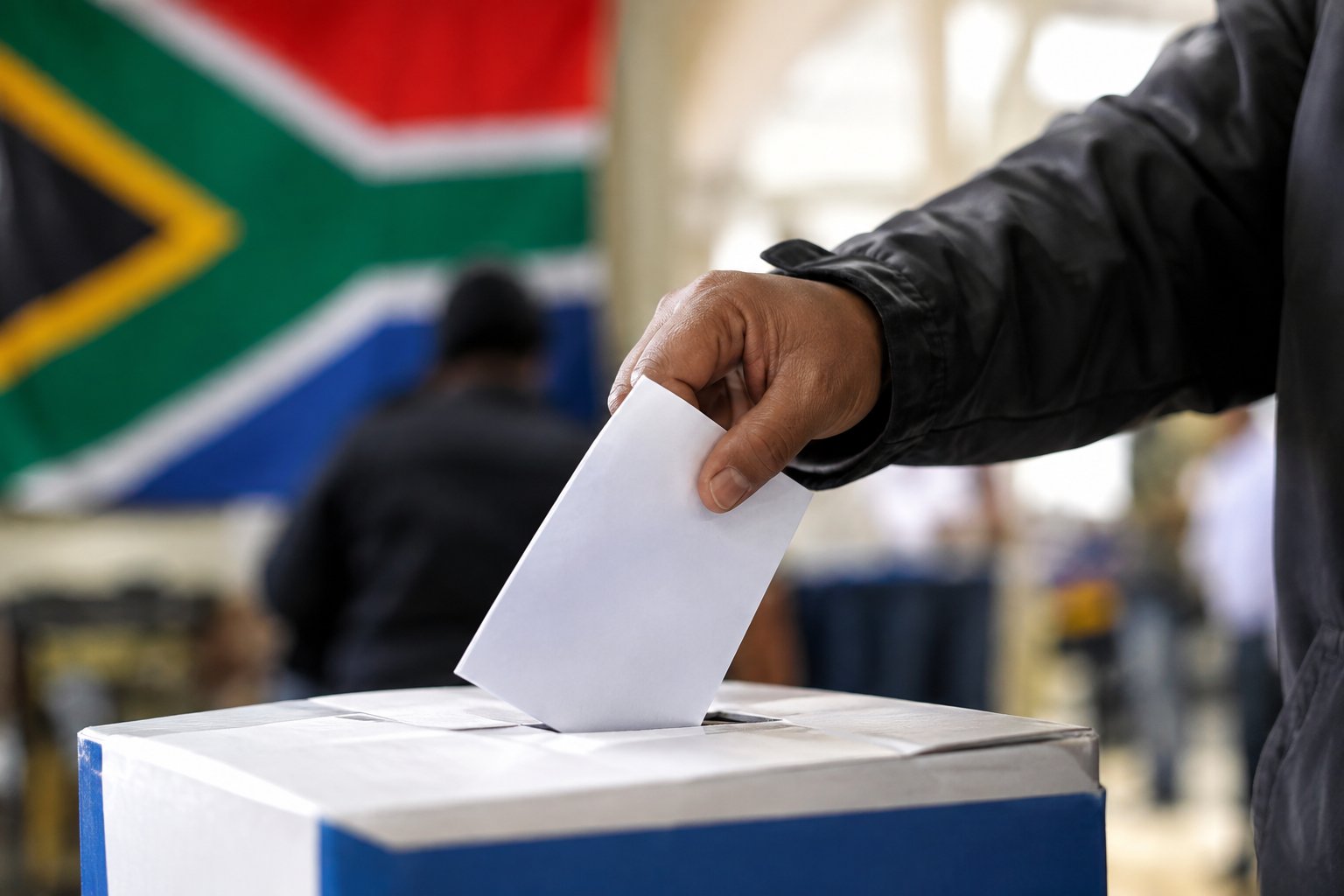
South Africa’s African National Congress (ANC) led the Democratic Alliance (DA) in early municipal election results on Thursday, November 5, according to Reuters. With 28% of votes counted by 09:22 GMT, the election commission’s results showed the ANC at about 32% and the DA at 28%. The vote took place on November 4; the count was still at an early stage and could change significantly.
What the early count shows
The figures reported by Reuters put the ANC narrowly ahead nationally, but they do not establish the final result. If the ANC’s share remained at about 32%, it would be around 14 percentage points below its 2021 municipal election result. Reuters described that 2021 result as already the party’s worst in its history.
The tally also showed different patterns across parts of the country. Reuters reported that the DA was performing strongly in several major cities. In KwaZulu-Natal, former president Jacob Zuma’s uMkhonto weSizwe party and the Inkatha Freedom Party were ahead of the ANC, according to the early results described by the news agency.
The figures drew contrasting responses from party figures. “The ANC is performing worse than expected – and expectations were already low,” Louw Nel, a senior political analyst at Oxford Economics Africa, told Reuters. He said a result of 32% would be “the party’s worst nightmare coming true.” DA Johannesburg mayoral candidate Helen Zille said, “It’s still early days and in this early on you can’t really call the outcome. But I think we will do well and I am very excited.” ANC chairperson Gwede Mantashe said the trends were not final, adding: “We may improve. … Major areas, townships, and other areas have not been counted yet.”
Why the result matters
Municipal results determine the party balance in local contests, and the early figures suggest a competitive field in several major urban areas. Reuters reported that Johannesburg is among the key municipalities where no single party is expected to win an outright majority. If that holds, parties will have to negotiate to form coalition governments.
Johannesburg is especially significant for the DA: winning the city would be a major boost for the party, which already controls Cape Town, Reuters reported. The early national tally may also be relevant to the next national election, scheduled for 2029. Reuters said the DA hopes to become the country’s largest party then, while cautioning through its reporting that the municipal count was incomplete. The figures are a snapshot of an ongoing local election count, not a settled measure of future national support.
Background to the ANC’s position
The ANC has been South Africa’s largest party since it led the country out of apartheid in 1994. Reuters noted that it has tended to perform worse in municipal elections than in national elections and has acknowledged failures in local governance.
Before the November 4 vote, the ANC was widely expected to lose ground nationally. Reuters reported that voters were expected to punish the party over high crime rates, corruption scandals and shortcomings in basic services such as water and electricity. These were reported as factors behind expectations, not as findings established by the early count itself.
A projection from South Africa’s Council for Scientific and Industrial Research suggested the ANC could finish with the same percentage of votes as it had in the early results. That projection and the partial tally are not final results; the count could still change as more votes are included.
What happens next
Reuters reported that the results were expected to be declared on Sunday. Parties would then have two weeks from the declaration to negotiate coalitions in municipalities where no party secured an outright majority.
Analysts cited by Reuters said an ANC-DA partnership could be the best option for stability in cities such as Johannesburg, pointing to the parties’ arrangement in national government. The parties remain opposed on key issues, including racial redress. Another possible route described by Reuters is an ANC coalition with the leftist Economic Freedom Fighters and uMkhonto weSizwe, excluding the DA.
For now, readers should treat the reported percentages as preliminary. The declared results and subsequent coalition negotiations will clarify which parties can form local governments; Reuters reported that the early tally alone did not settle those outcomes.
Source: internazionale.it
About the author
Editorial persona of Polity Atlas.