
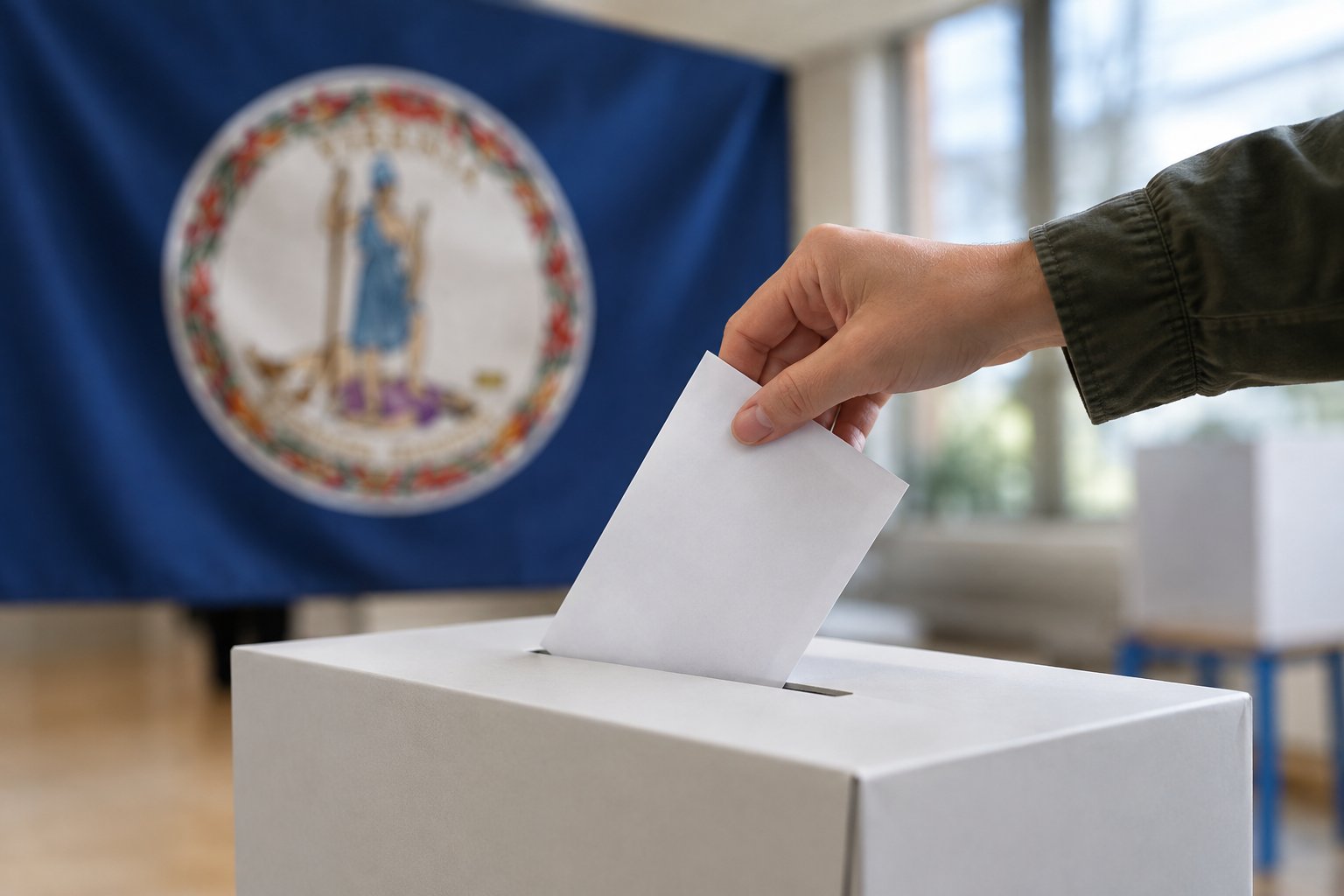
Virginia voters approved three amendments to the state constitution on Nov. 3, covering reproductive healthcare, marriage equality and voting rights after felony convictions. The WHRO reported the results on Nov. 4, citing The Associated Press. The reproductive-rights amendment faces a court challenge, so its certification remains a point to watch.
What voters approved
The three ballot questions address distinct provisions of Virginia’s constitution. According to WHRO’s account of the AP calls, the AP called Ballot Question 1 shortly after 9 p.m., with “Yes” leading 60.9% to 39.1%. Calls in favor of Questions 2 and 3 followed just after 9:30 p.m. The AP called Question 2 at 9:31 p.m., with 56.1% voting “Yes” and 43.9% “No,” and called Question 3 at 9:34 p.m.
Question 1 protects reproductive freedom, including decisions relating to prenatal care, childbirth, contraception, abortion, miscarriage management and fertility care. WHRO reported that the amendment allows abortions through the second trimester, decreases barriers to third-trimester abortions, protects contraception and fertility care, and shields healthcare providers from criminal prosecution. After certification, the constitution would state that every individual has a fundamental right to reproductive freedom.
Question 2 removes the constitution’s current wording that recognizes marriage only between a man and a woman. Once results are certified, the replacement language will describe marriage as a vital personal right and bar officials from denying a marriage on the basis of sex, gender or race. WHRO reported that the amendment does not change anything immediately, but is intended to guard against the possibility that the US Supreme Court could overturn its 2015 decision in Obergefell v. Hodges.
Question 3 changes the state’s rules on voting rights after felony convictions. WHRO reported that the amendment provides for automatic restoration upon release from incarceration for Virginians convicted of three disqualifying felonies: murder, voluntary manslaughter and involuntary manslaughter. It also establishes a fundamental right to vote, confirms that incarcerated people cannot vote in Virginia, and changes the standard courts use to assess whether someone lacks the capacity to understand voting.
What the changes mean
For Virginia residents, the amendments concern constitutional protections and rules, not just statements of policy. The reproductive-rights measure would place a right to make decisions about reproductive care in the state constitution. WHRO reported that, barring federal legislation restricting abortion nationwide, those protections could not be restricted by a Virginia legislature and governor opposed to abortion.
The marriage measure would remove language adopted in 2006 that defined marriage as between one man and one woman. WHRO reported that it also codifies the principle associated with Loving v. Virginia, the 1967 Supreme Court case permitting interracial marriage. The voting measure changes how rights are restored and how courts assess capacity, while retaining the rule that incarcerated people cannot vote.
These are the reported effects of the amendments; the precise status of the reproductive-rights measure depends on the certification process and the pending court case. The reported results alone do not resolve that challenge.
How Virginia got to this vote
Virginia requires a proposed constitutional amendment to pass the legislature twice, with an election for the House of Delegates between those votes. WHRO reported that Republicans in the House defeated the reproductive-rights amendment in 2023; Democratic legislative majorities later referred it to voters after passage in 2025 and 2026. Democrats had pursued the measure after the US Supreme Court overturned Roe v. Wade in June 2022.
The marriage amendment follows a different legal history. Virginia adopted the Marshall-Newman Amendment in 2006, defining marriage as a union between one man and one woman. In 2015, the Supreme Court’s Obergefell decision found that the US Constitution’s due-process and equal-protection clauses protect same-sex unions. WHRO reported that the later decision in Dobbs v. Jackson Women’s Health Organization weakened the due-process protection, raising concerns among advocates that Obergefell could be overturned.
For voting rights, WHRO reported that Virginia previously disenfranchised people convicted of a felony and gave the governor sole authority to restore their rights. That framework applied to roughly 1,000 felonies outlined in state law. Legislators had introduced proposals for automatic restoration over several decades. WHRO also reported that the practice dates to Virginia’s 1902 constitution, when lawmakers introduced it with the intent of disenfranchising Black Virginians.
What remains to be confirmed
The immediate outstanding issue identified by WHRO is a court challenge to Question 1. The Founding Freedoms Law Center, the legal branch of the Family Foundation, argues that the ballot language was misleading and has asked Tazewell Circuit Court to block certification of the election results. WHRO reported that the hearing is scheduled for Nov. 13.
“The fight’s not over,” Jessi Blakely, state director for Family Foundation Action, told WHRO. The reported vote calls therefore should be distinguished from the final certification of results. For the other amendments, WHRO described the constitutional text changes as taking effect once results are certified.
Fonte: intelligence
Sobre o autor
Editorial persona of Polity Atlas.