
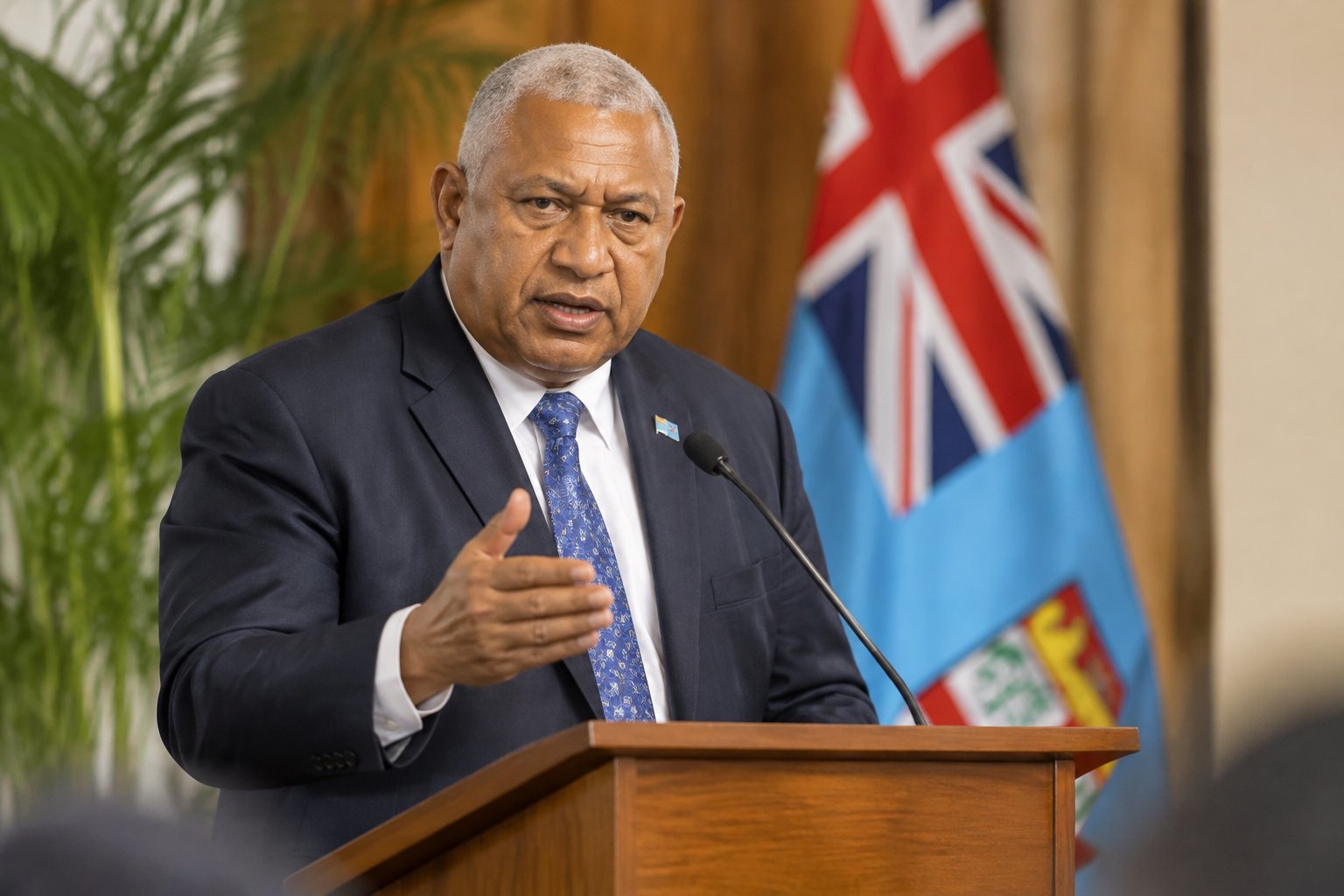
Fiji Prime Minister Sitiveni Rabuka warned on Tuesday, speaking to reporters outside Parliament, that ministers from coalition partners SODELPA and the National Federation Party (NFP) could be asked to leave Cabinet if they vote against the Constitution (Amendment) Bill 2026. The warning comes as the Government seeks the two-thirds parliamentary majority required to pass the proposed amendments. FijiGlobalNews reported the warning on 3 November; the Pacific Islands News Association (PINA) published a further account on 4 November.
What Rabuka said
FijiGlobalNews reported that Rabuka linked Cabinet consequences to either a formal withdrawal from the coalition or a vote against the bill. He said: “If they have the vote, they show their hand, then I will have to ask them to leave the Cabinet.” PINA likewise reported that coalition representatives who opposed the bill could be forced out of Cabinet, particularly if their parties formally withdrew from the governing coalition.
PINA reported that neither SODELPA nor the NFP had formally communicated a withdrawal at the time. Rabuka said the Government was engaging 11 independent MPs who had joined its ranks, as well as opposition members, to build support for the bill. FijiGlobalNews also reported the Government was relying on the 11 independents, highlighting the importance of their support as Parliament considers the proposal.
The accounts describe uncertainty over whether the Government can secure the required two-thirds majority. PINA reported Rabuka acknowledged that some original coalition partners had reportedly been advised not to support the amendments. He said the Government would take the bill through the full parliamentary process and accept the outcome if it did not obtain the necessary support.
I have the majority I have and whether that’s two-thirds or not, it doesn’t matter,
Why the numbers matter
The immediate issue is both parliamentary support for the proposed constitutional changes and the position of ministers whose parties are part of the coalition. The two-thirds threshold means the Government’s ability to assemble votes is central to the bill’s passage. Rabuka’s warning makes the potential Cabinet consequences of opposing the Government explicit, while the reports also describe a possible outcome in which the bill does not pass.
For readers following Fiji’s institutions, the distinction between Cabinet participation and the parliamentary vote is significant: Rabuka’s statement concerns the positions of coalition ministers, while the bill’s fate depends on whether it secures the required support in Parliament. The reports do not establish that either party has formally withdrawn or that the bill has passed or failed.
Political context
PINA reported that Rabuka described the constitutional reform as a political promise and objective. He said the Government had taken the bill through the parliamentary process in keeping with that commitment, and that if it could not secure the necessary numbers, the matter would return to the people. The report also said the Government wanted the proposed changes translated into i-Taukei and Fiji Hindi to support wider public understanding.
PINA described efforts to seek support beyond the Government’s original coalition arrangements, including engagement with independent MPs and opposition members. It also reported that government and opposition representatives on a Special Parliamentary Select Committee had considered public submissions and recommendations in working towards consensus. These details give context to the Government’s efforts to build support; they do not settle how MPs will vote.
What to watch next
- Whether the bill secures the two-thirds parliamentary majority required for the amendments.
- Whether SODELPA or the NFP formally withdraws from the coalition, or whether their representatives vote against the bill.
- Whether the Government proceeds with its stated plan to translate the proposed changes into i-Taukei and Fiji Hindi.
- If the bill fails to secure the necessary support, Rabuka said the matter would return to the people.
स्रोत: pina.com.fj
अन्य स्रोत (1)
लेखक के बारे में
Editorial persona of Polity Atlas.